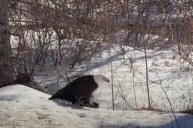

A bald eagle is fighting for its life after getting severe lead poisoning. The bird appears to have eaten lead bullets from animal carcasses. During the winter, eagles and raptors scavenge for food due to scarcity. This can lead them to feast on carcasses and ingest lead bullet fragments.
Sadly, this can cause them to get very sick. In Elizabeth, Colorado, one bald eagle was close to death's door. That's when some farmers found it and took it to the Rocky Mountain Wildlife Alliance. Even with this intervention, founder and executive director Emily Davenport told Cowboy State Daily it's hard to say if the bald eagle will live.
"It's very much so touch and go. I would say he's still in critical condition and his prognosis is still guarded," she said. "We'll keep fighting as long as he wants to keep fighting."
The bald eagle is young and can live 20 to 40 years under normal circumstances. But this bird is experiencing lead poisoning symptoms. A farmer noticed him.
"He thought that it was unusual that the bird had barely moved for three days," she said.
The bald eagle couldn't stand, much less fly.
Bald Eagle Fights For Its Life
"We walked them through, in detail, what they needed to do to catch the bird without getting hurt themselves — and not injuring the bird," she said. "His poisoning was so severe, our machine couldn't even read the levels. It was probably a couple of days away from death."
Lead poisoning has neurological effects and disrupts digestion, leading to starvation.
"Even if food is available to eat, they slowly starve to death. That's what was happening to this bird, it was on the edge of starvation," Davenport said. "He's held down a few small meals now, which seems tiny, but that's significant progress."
The center is putting the bald eagle through a process similar to chemotherapy to remove the lead. Bryan Bedrosian, conservation director at Wyoming's Teton Raptor Center, explained what chelation therapy is.
"It introduces a chemical that binds to the lead that's circulating in the blood of the bird, and it essentially gets pooped out," he said. "We've had eagles that we've had to give four rounds of chelation treatment."
Hopefully, the bird will survive.